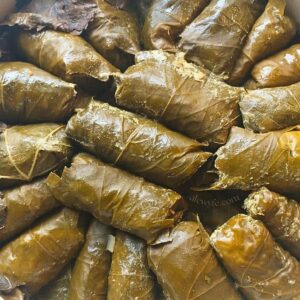
Dolmades with Currants and Nuts (Vegetarian Stuffed Vine Leaves)
These vegetarian dolmades are stuffed with a savory filling of rice, dried currants, herbs, spices, and pine nuts (though they're also nice with slivered almonds or chopped walnuts). These tasty little bundles, wrapped in brined vine leaves, are a flavorful and portable snack or elegant appetizer.
Ingredients
- 16 oz jar brined grape vine leaves (about 85 leaves)
Vegetarian dolmades filling:
- 1 ¼ cups long grain white rice (uncooked)
- 1 cup white or yellow onion, finely minced
- 2 large eggs
- ¼ cup extra virgin olive oil
- 3 tbsp lemon juice
- 3 tbsp fresh parsley, chopped
- 3 tbsp fresh dill, minced (substitute mint for up to half of the dill)
- 2 tbsp dried currants
- 2 tbsp pine nuts (substitute slivered almonds or chopped walnuts)
- 1 tsp kosher salt
- ¾ tsp black pepper (preferably freshly ground)
- ¾ tsp ground cumin
- ¼ tsp garlic powder
- ¼ tsp dried oregano
- ⅛ tsp cinnamon
Cooking liquid:
- 1 quart vegetable or chicken stock (use vegetable stock for vegetarian dolmades, or chicken stock for more flavor if you're not serving vegetarians)
Instructions
one: ingredient prep
- Peel and mince your onion very finely (1/8"-1/4" pieces).
- This is best done by cutting the onion in half vertically (cut through the root end, after trimming of the top and roots), then removing the peel.
- Lay the onion half down on your board, root end towards your non-dominant hand.
- Using a sharp knife, cut the onion almost all the way to the root end into thin strips (leave the root end so that it holds the pieces together) then slice again, perpendicular to the first rows of cuts. Some people also like to cut first into the onion horizontally for even smaller pieces.
- Wash, dry, and mince your herbs, and get out all of your other ingredients.
two: mix filling
- In a small mixing bowl, combine the uncooked rice, the minced onion, currants, pine nuts (or other nuts as indicated in the ingredients section) chopped parsley and dill (or mint), the eggs, lemon juice, olive oil, and the spices.
- You may want to whisk the eggs together first before adding the other ingredients, otherwise, mix very thoroughly so that they are well combined with no visible bits of yolk or white.
- Stir the mixture until it is well combined, and the herbs and spices are distributed throughout.
three: prepare grape leaves & pan
- Open your jar of vine leaves (or fresh vine leaves, blanched in salted water, if you know how to prepare them and have access to those). Drain, unroll, and rinse the leaves in a colander to remove excess salt.
- Pick through them quickly, and set any torn, very small, or unevenly shaped leaves aside and use these to line the pan that you will be using to cook your dolma.
- You want a layer of leaves on the bottom between the heat and your stuffed vine leaves so that they don't scorch. If your pan is very thin, you may want to use a heat-resistant plate, or a metal or silicone trivet on the bottom if you have one, or use a heavy pan.
four: stuff dolmades
- Now that your pan is prepared, begin to roll up your dolmades. I like to use a small quarter-sheet pan as a clean work surface to contain any liquid, but you can also use a cutting board, plate, or clean counter top.
- Spread out a large vine leaf with the smooth side down and the leaf veins pointing up (or splice two together overlapping if the leaves are very serrated)
- Place a small spoonful of the rice mixture on the center of the leaf, towards the base of the leaf where the veins branch out. Adjust the amount for the size of the leaf, but between two teaspoons and a tablespoon (remember that it will expand as the rice cooks).
- Fold the sides of the leaf over the filling, then roll from the base of the leaf towards the edges into a date-sized bundle (you may need to fold the sides in again). Do not fold them too tightly, or they will burst when the rice cooks.
- Place the rolled leaf into your prepared pan and repeat to roll up the next.
- Leave room for the dolmades to expand while they cook, packing them gently in concentric rings starting at the outside of the pan and working inwards. You will probably need to stack them in two to three layers.
five: add broth
- When you have stuffed all of the filling into leaves, use any remaining grape leaves to cover the top of the pan.
- Place a heat-proof plate or other food-safe, heat-resistant weight on top of the dolmades to keep them from floating and under the liquid while they cook (or they may break up, or be dry). You can skip this if your dolma completely fill the pan and have a tight fitting lid to hold them in place (my pan exactly holds one batch without room for a plate on top, but if you are using a dutch oven or other large pot, you will need to weight them).
- Heat up the vegetable broth or chicken stock while you are rolling the dolma. Don't boil it out, but bring it up almost to a simmer and keep warm (this is optional but if you don't your dolma will take much longer to cook).
- Carefully pour the hot broth over the dolma (weighted if necessary to keep them from floating).
- If there is not enough liquid to cover, add additional broth or hot water.
six: simmer the dolmades
- Cover the pot tightly, and carefully place the pan on medium heat, bringing it up to a simmer.
- Reduce the heat to low, and simmer for about 45-60 minutes, until the rice in the dolma is cooked through (it might be a bit al dente) and most of the liquid has been absorbed.
- You may need to add additional stock or water during cooking to keep the top layer of dolmades moist
seven: cool and rest
- Remove the pan from the heat and let cool. Keep covered, and when the pan is cool to the touch, place it in the fridge (you can cool it quickly in summer by using an ice bath for food safety).
- Let the dolma rest and soak up the remaining liquid, ideally at least several hours. I like to make these in advance and let them chill overnight. They will be more tender as the rice will absorb the last of the cooking liquid, and the flavors will have time to meld.
- You can gently warm these before serving, serve them cold, or at room temperature.
Notes
Make-Ahead Tips: I recommend making these at least several hours in advance, and preferably a day ahead of serving. This is perfect for party planning or meal prep, as they can be done well ahead of any last minute preparations. You can refrigerate these for several days before serving. Keep them well covered so that they don't dry out.
Notes on Nutritional Information:
Values shown are an estimate, and calculated using pine nuts and vegetable stock. Substitutions will change the values.
Nutrition
Calories: 187kcalCarbohydrates: 27gProtein: 5gFat: 7gSaturated Fat: 1gPolyunsaturated Fat: 2gMonounsaturated Fat: 4gTrans Fat: 0.003gCholesterol: 31mgSodium: 528mgPotassium: 201mgFiber: 5gSugar: 5gVitamin A: 10714IUVitamin C: 8mgCalcium: 157mgIron: 2mg
Tried this recipe?Let us know how it was!
