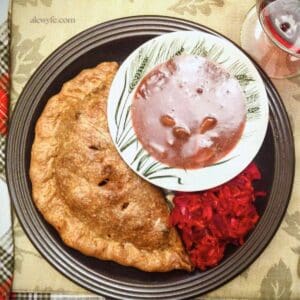
Yooper Pasties with Venison and Roasted Root Vegetables and Spent Grain Hot Water Pastry
Traditionally, the meat and fillings for pasties are diced small (1/4") and put in the pasty uncooked, to finish cooking while the pastry case bakes. You can do this, but I prefer to cut veggies into a medium or large dice (1/2"-3/4"), sear the meat first (1" cubes raw, as they'll shrink slightly) and roast the veggies on lightly oiled sheet pans. It's an extra step, but the Maillard reaction you get from roasting and browning the components first adds sweetness to the vegetables, umami to the meat, and a general depth of flavor to the filling that I think is worthwhile, especially in winter! If I'm baking these in the summer, I'll go the traditional route to cut down on oven time.
Equipment
- Rolling Pin
- large mixing bowl
- cutting board & sharp knife
Ingredients
Spent Grain Hot Water Butter Crust
- 3½ cups all purpose flour (plus extra for bench flour when working with the dough)
- ½ cup dried, milled, and sifted spent grain flour (can substitute rye, barley, or whole wheat pastry flour)
- 1 tbsp kosher salt (reduce slightly if not using kosher flakes)
- 8 oz butter or lard (2 sticks, room temperature or chilled)
- 1 cup HOT water (8 oz, boiled and very slightly cooled)
Venison and Root Vegetable Pasty Filling
- 3 lb venison roast or steak, cut into 1" cubes (can substitute ground venison, or use beef, mutton, lamb, or goat)
- 3-5 cloves garlic, peeled and minced (not traditional, but why wouldn't you?)
- 1 lb yukon gold or red potatoes, scrubbed and small-medium diced (peel the potatoes if you like or if skins are thick)
- 1 medium rutabaga, peeled and small-medium diced
- ½ lb carrots, peeled and small-medium diced
- 2 medium onions, peeled and small-medium diced
- 3-4 stalks celery, washed and small-medium diced (optional, but not traditional)
- 1 tbsp flaky kosher salt or to taste (use less regular salt if you substitute)
- 2 tsp fresh ground pepper or to taste
- 1-2 tsp dried thyme or marjoram (not traditional, but nice)
- 3-4 tbsp olive oil or neutral oil for roasting veggies & searing meat
Instructions
Spent Grain Hot Water Crust
- By Hand: Combine dry ingredients in a large mixing bowl. Cut butter or lard into 8-10 chunks and add to the dry ingredients. Using a pastry cutter or your fingers, rub or cut in butter until the mixture is crumbly and no larger than pea-sized chunks remain.By Machine: Combine dry ingredients in a stand mixer with paddle or food processor bowl with blade. Add the chunks of fat as above, and mix or pulse food processor until crumbly.
- By Hand: Add the almost boiling water and mix with a silicone spatula or wooden spoon. Once the dough is just cool enough to handle, knead it lightly in the bowl to combine, or turn it out onto a lightly floured surface and use a bench scraper and then your hands to lightly knead it until it comes together... not as thoroughly as a bread dough- you are not trying to develop the gluten (which has been coated by the fat) but you don't have to be as delicate with it as a typical pie crust. If it's very sticky, gently knead in more flour until it feels workable (dough will be soft while it's hot). By Machine: Pour in the almost boiling water in a steady stream while the mixer is running (pulse food processor so you don't overwork the dough). Turn dough out onto lightly floured surface or shallow bowl proceed as above.
- You can use the dough immediately (though it will be soft and harder to work with), or wrap the dough ball tightly with plastic wrap, or oil the surface of the dough and place in a tightly covered bowl. Let dough rest in fridge while you make the filling.
Venison and Roasted Root Vegetable Filling
- Dice the veggies- see note above about sizing. If you are roasting the veggies, cut medium to large dice (1/2"-3/4"), and preheat the oven to 400° F. Otherwise, cut small dice (1/4"). Whichever you choose, it's important to try to keep the pieces a uniform size so that they cook evenly.
- For roasted veggies, spread them out in a single layer on sheet pans and toss with vegetable oil (olive oil or your choice of neutral flavored oil). Season with salt and pepper and roast until they just start to turn tender and sweet (25-35 minutes, but this will vary based on your oven and size of dice).
- While the veggies are roasting, you will lightly sear the meat. Season first with salt and pepper to taste, and get a large heavy (preferably cast iron) pan hot over medium-high heat. You want a hot pan so you can get a good sear, but not quite smoking hot. Add a couple tablespoons of high heat oil (like peanut or grapeseed) or tallow or lard and then immediately add the cubes of meat- they should sizzle immediately but not burn. Leave them to sear a bit on each side before turning them. A good pair of tongs are helpful here.
- When the meat is browned, add the thyme and garlic, if using. If you are working with a tender cut of meat, this is all they will need. If the roast you cubed is tougher, you can deglaze the pan with some wine or stock (or even hot water) and let them braise a bit at a low simmer until they are tender and the excess liquid evaporates (or drain and save this liquid for gravy).
- In a large bowl or roasting pan, combine the meat and veggies and adjust seasoning if necessary. Let cool slightly while you roll out the dough.
Pasty Assembly
- You can make large dinner plate sized pasties or smaller snack sized hand-pies- it's up to you! Dough makes about 8-9 large pasties, or 12-18 smaller pasties.Portion the dough out into balls, and keep covered while you roll out individual circles on a lightly floured surface or Silpat. Use a bench scraper if the dough is sticking.
- The quantity of filling for each pie will vary depending on the size of the pies- add a generous scoop of filling to the center of the circle that will still allow you to close the pastry.
- Using a bench scraper or metal spatula, lift the top half of the dough circle and fold over to form a half moon. The dough should easily seal to itself, but if it is dry, you can brush it with water, milk, or egg wash.
- Fold the rounded edge of the dough over onto itself and crimp the dough closed using your forefingers or knuckles. You can also use a floured fork to crimp the edge sealed after you fold it over.
- Lift the pasty onto a baking sheet with your bench scraper or a spatula, and repeat until you are out of dough or filling. Using the tip of a paring knife, cut 2-3 small steam vents in the tops by lightly poking and twisting the dough with the knife.
- If you want glossy pasties, brush lightly with egg wash, milk, or melted butter. Remaining dough can be refrigerated for a day or frozen for several weeks. Remaining filling freezes well for quick pasties, or can be added to a stew or casserole.
Bake the Pasties
- Bake the pasties in a hot oven (425° F) for 10-15 minutes, then reduce oven temp to 350° F. Large pasties can take another 30-50 minutes, while smaller ones will cook faster. The pastry will be fully set, and lightly golden brown, especially if you glazed the pastry, and the filling will be hot and cooked through.
- If you are uncertain (especially if you used a raw filling) use a calibrated thermometer to check the temperature of the center of the filling. It should be at least 145℉, which will carry over a bit. If you are using commercial ground meat, err on the side of caution and make sure the center reaches 165℉ for food safety.
Notes
To freeze, let baked pasties cool, then wrap in foil. Store in ziplock bags or tightly sealed freezer containers, and reheat in the foil- no need to thaw (remove foil if using a microwave, though this will make them soggy- an oven or toaster oven is best).
Nutritional information is an estimate for 9 large pasties, and calculated using malted barley flour for the spent grain flour and butter in the dough.
Nutrition
Calories: 692kcalCarbohydrates: 62gProtein: 43gFat: 30gSaturated Fat: 15gPolyunsaturated Fat: 2gMonounsaturated Fat: 10gTrans Fat: 1gCholesterol: 183mgSodium: 1830mgPotassium: 1064mgFiber: 6gSugar: 5gVitamin A: 4911IUVitamin C: 25mgCalcium: 76mgIron: 9mg
Tried this recipe?Let us know how it was!
