COOK: Foolproof Homemade Tortillas
- Homemade Hybrid Tortilla Ingredients
- Kitchen Equipment Needed
- How to Make Foolproof Hybrid Tortillas
- Storage & Serving Ideas
- Foolproof Homemade Tortillas
This hybrid corn and flour tortilla recipe is my favorite for homemade tacos, combining the superior flavor of corn tortillas with the flexibility of flour ones. They stand up to the drippiest taco fillings without cracking or splitting, and are never dry. The dough is soft and so nice to work with, even if you’re new to making tortillas, and easy to press into perfect circles.
Once you’ve tasted fresh homemade tortillas, it’s hard to go back to the often tasteless, dry store bought ones. We’re fortunate here in Chicago that there are multiple local tortillerias that sell their tortillas in grocery stores as well as directly.
My favorites, El Milagro, are often still warm in the boxes when they are put out on the shelves at our neighborhood grocery store. I’ve even heard of former Chicagoans bringing an entire empty carry-on suitcase with them on a trip that they filled with packets of these tortillas to bring with them on their flight back home (they freeze well, especially if you vacuum seal them).
But even these locally made shells aren’t as good as homemade tortillas hot off the comal (griddle)! Best of all, while it might seem intimidating, they’re actually really simple to make. Once you get the hang of it, you can get into a relaxing flow-state of pressing, cooking, and flipping the tortillas. I like to make a big batch, enjoying some right away, and portioning and freezing some for future meals when I don’t have time to make them from scratch.
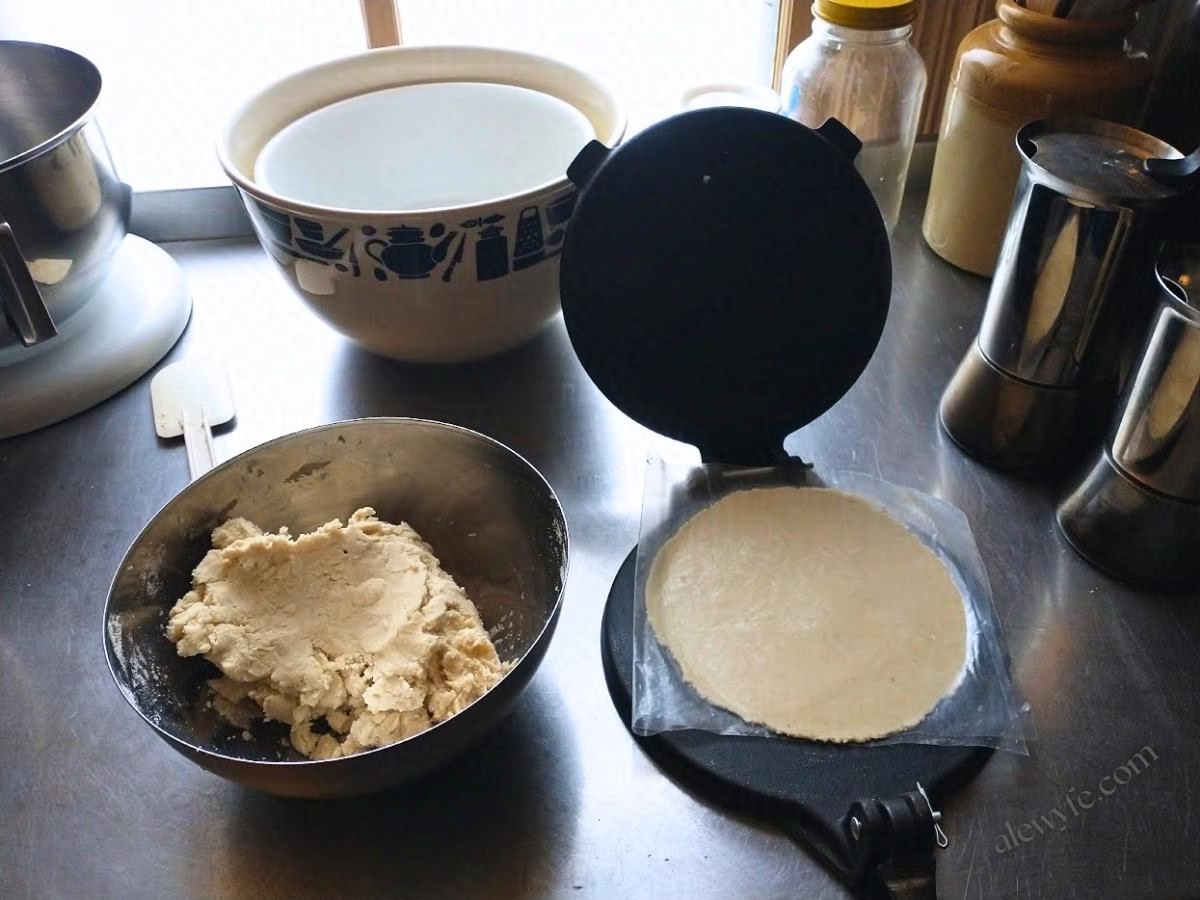
Homemade Hybrid Tortilla Ingredients
Corn masa flour:
The corn masa adds a sweet, earthy flavor that you just can’t get with flour tortillas. You can use white, yellow, or blue corn masa flour (or even red corn masa if you can find it).
I prefer a finer grind for making tortillas. You can make tortillas with the coarser masa sold for tamales, but the regular finely ground masa flour is best and easier to work with.
AP flour:
The wheat flour adds structure to the dough, and makes it easier to work with than straight corn masa. The gluten in the wheat helps the tortillas stay together, and you can handle the dough and the finished tortillas without tearing.
You can try using whole wheat flour for all or part of the AP flour, but may need to increase the water amount, and your whole wheat tortillas won’t be as tender as ones made with white flour. They will be higher in fiber and have a robust flavor though!
Water:
This recipe works best with very hot water. Either use the hottest water from your kitchen tap, or bring a kettle almost to a boil and let it cool for a few minutes.
Fat:
Traditional corn tortillas don’t usually include oil, while flour tortilla recipes need some to make them pliable and keep them from drying out. Not only does fat add flavor, but it keeps your tortillas from drying out as fast, makes the finished tortillas more pliable, and helps make the dough a dream to work with.
I usually use olive oil, but you can also use melted coconut oil, lard, or butter, or a neutrally flavored vegetable oil.
Salt:
Just a pinch of salt adds flavor and complexity.
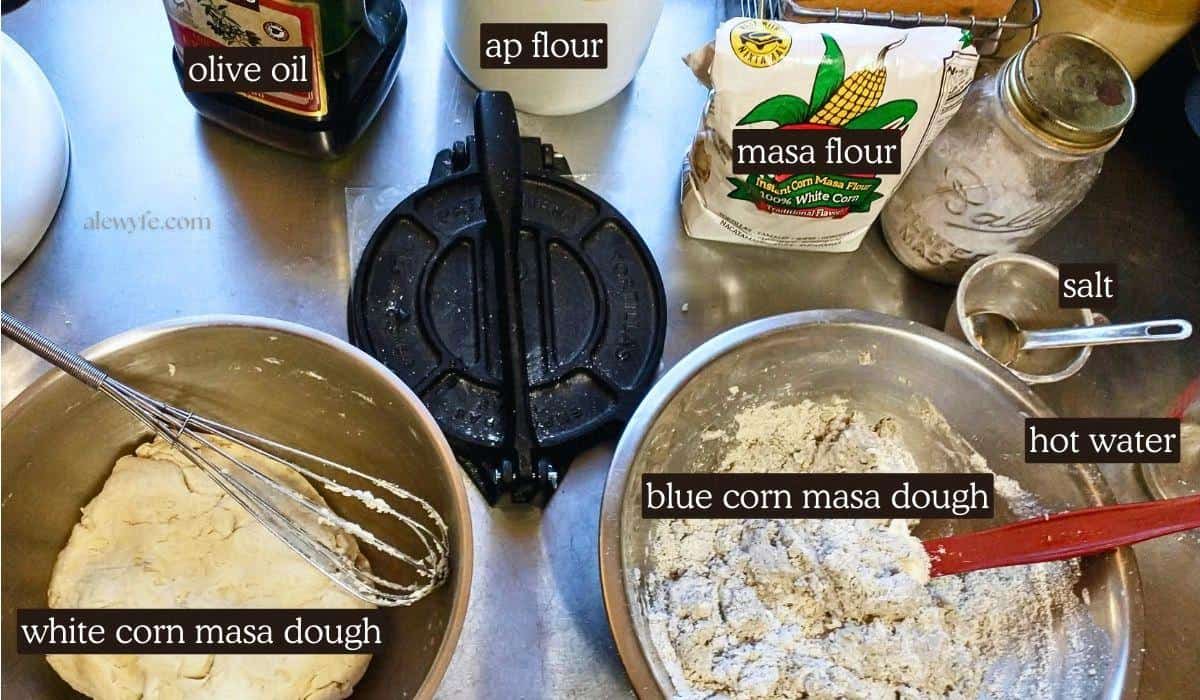
Kitchen Equipment Needed
Tortilla press:
This isn’t absolutely essential, but if you are going to be making a lot of tortillas, it’s a game-changer. I use mine for tortillas, of course, but it’s also handy for pressing dough flat for dumplings or pierogi, or at least for the initial press before rolling the dough thinner with a small rolling pin. But for soft tortilla masa, the tortilla press is all you need and will make having homemade tortillas doable in a hurry and with minimal fuss.
I have an 8″ cast iron one from Victoria, which makes pressing the dough even easier than with the lighter aluminum presses, since it has a fair amount of heft and needs minimal elbow grease to use. You can also get smaller ones for just mini taco shells and dumpling dough, or larger 10″ burrito shell presses, but the 8″ press is a good compromise between versatility and weight for most kitchens.
You’ll want to line the tortilla press so that the dough doesn’t stick and is easy to transfer to the griddle. You can use plastic wrap, but it’s not ideal, and tends to stick or tear. Parchment circles work if you want to cut them out (or have pre-cut cake rounds).
The best thing I’ve found to line a tortilla press is a plastic quart freezer bag, with the sides and zip-top cut off, leaving a sturdy folded piece of long, thick plastic that you can line up with the hinge of the press.
You can wash and re-use the same piece for quite a while, so it’s less wasteful than tossing one-time use plastic or parchment, but inexpensive to replace when the plastic eventually is less smooth or tears and your masa dough starts to stick to it.
Rolling pin (alternative to press):
If you don’t have a tortilla press, you can roll the dough out by hand with a straight rolling pin. You’ll need to sandwich the dough between layers of parchment paper, nonstick silicone baking sheets, or using the plastic zip-lock bag trick described above (my favorite).
You can also use one or two cast-iron or other heavy, smooth-bottomed pans to improvise a tortilla press, but this only really works if they sit flat on the work-surface and have smooth bottoms.
Comal (griddle):
You’ll need a large, flat surface to cook your tortillas. I use a heavy cast-iron griddle, which allows me to cook two to three taco-sized tortillas at once. You can also use a large cast iron skillet, or in a pinch, any skillet with a heavy bottom that you can evenly heat.
If you have a cast iron pizza stone or outdoor griddle (like a Blackstone), they’re great for making big batches of homemade tortillas in a hurry, for parties, or to freeze for later use. And you won’t heat up your house (though flatbreads like tortillas are already a better hot-weather baking option, since you won’t need to heat up your oven).
How to Make Foolproof Hybrid Tortillas

make masa dough:
- In a medium bowl, mix the masa flour, all purpose flour, and salt. Whisk or stir until well combined.
- Rub or cut in the fat until it is completely incorporated and the mixture takes on a sandy texture.
- Add hot water and stir, then knead gently until the dough forms a smooth, cohesive ball.
knead & rest dough:
- Adjust and add another teaspoon of water if the dough is still too dry or crumbly. It should be soft but not sticky.
- Let the dough rest for 20-30 minutes, tightly wrapped or covered so that it doesn’t dry out. You can also refrigerate the dough at this point for up to a day or two. The rest lets the masa flour absorb the water, and the gluten in the wheat flour relax, so that your tortilla masa dough is easier to handle.
pre-shape & press tortillas:
- Begin preheating the comal (a heavy griddle or large cast iron skillet works well) over medium high heat.
- Break off a walnut sized chunk of dough, and roughly roll it into a ball.
- Using a tortilla press lined with heavy plastic or parchment paper, press the ball into a flat disc. If you don’t have a tortilla press, you can roll the dough out between sheets of parchment or silicone baking mats, or improvise a tortilla press using the smooth bottoms of two small saute or cast iron pans.
cook tortillas:
- Test the griddle by flicking a few drops of water on the surface… when they jump and sizzle, it’s ready.
- Carefully peel the pressed or rolled tortilla from the plastic or parchment, and toss it onto the hot griddle. I find this easiest by first peeling one side free, then laying the dough side on your outstretched hand as you peel back the other side. Then, quickly flip your hand over above the griddle.
- Once the first tortilla is on, work quickly to roll and press the second. Flip the first tortilla onto the back of the griddle, then replace it with the freshly rolled one.
- Continue pressing, flipping, and stacking the tortillas until you have cooked them all.

Storage & Serving Ideas

Try our simple salsa recipes on your tortillas!
- Wrap the warm cooked tortillas in a clean tea towel, or place them into a tortilla warmer.
- They’re most delicious served warm, fresh off the griddle. But even reheated or cold homemade tortillas are miles above anything you can buy in the store.
- If you are making these in advance, wrap them in meal-sized bundles with parchment or waxed paper, then sealing these in zip-lock bags.
- You can refrigerate your fresh tortillas for a few days or as long as a week.
- To keep them longer, freeze them tightly wrapped for up to three months (you can keep them longer but they’re more likely to dry out or get freezer-burned).


Foolproof Homemade Tortillas
Equipment
Ingredients
- 1 cup corn masa flour
- 1 cup all purpose flour
- ¾ cup hot water
- 3 tbsp olive oil, melted coconut oil, or melted butter you can substitute other vegetable oil or melted lard
- ½ tsp salt
Instructions
Make masa dough:
- In a medium bowl, mix the masa flour, all purpose flour, and salt. Whisk or stir until well combined.
- Rub or cut in the fat until it is completely incorporated and the mixture takes on a sandy texture.
- Add hot water and stir, then knead gently until the dough forms a smooth, cohesive ball. Adjust and add another teaspoon of water if the dough is still too dry or crumbly, or cracks when pressed. It should be soft but not sticky.
Rest dough:
- Let the dough rest for 20-30 minutes, tightly wrapped or covered so that it doesn't dry out. You can also refrigerate the dough at this point for up to a day or two.
- The rest lets the masa flour absorb the water, and the gluten in the wheat flour relax, so that your tortilla masa dough is easier to handle.
Press and cook tortillas:
- Begin preheating the comal (a heavy griddle or large cast iron skillet works well) over medium high heat.
- Break off a walnut sized chunk of dough, and roughly roll it into a ball. You can also roll all of the dough out into a log, so that it is easier to portion evenly.
- Keep the unused portions of dough covered lightly with plastic wrap or a damp towel.
- Using a tortilla press lined with heavy plastic or parchment paper, press the ball into a flat disc. If you don’t have a tortilla press, you can roll the dough out between sheets of parchment or silicone baking mats, or improvise a tortilla press using the smooth bottoms of two small saute or cast iron pans.
- Test the griddle by flicking a few drops of water on the surface… when they jump and sizzle, it’s ready.
- Carefully peel the pressed or rolled tortilla from the plastic or parchment, and toss it onto the hot griddle. I find this easiest by first peeling one side free, then laying the dough side on your outstretched hand as you peel back the other side. Then, quickly flip your hand over above the griddle.
- Once the first tortilla is on, work quickly to roll and press the second. Flip the first tortilla onto the back of the griddle, then replace it with the freshly rolled one. You will need more time for the first few tortillas, but once you get the hang of it, you can press them as fast or faster than they cook.
- Continue pressing, flipping, and stacking the tortillas until you have cooked them all.
- Wrap the cooked tortillas in a clean, lightly damp tea towel or preheated tortilla warmer. Keep warm until serving, or wrap tightly and refrigerate or freeze.
Notes
Nutrition
Liked this? Try these related recipes!

- How to Make Turkey Mole Tamales
- Mincemeat Tamales with Pumpkin Masa
- Venison & Queso Chile Rellenos with Smoky Tomato Sauce
- Simple Sheet Pan Nachos
- Chipotle Barbacoa Beef or Venison (pressure-canning recipe)
- Taqueria-Style Pickled Jalapenos & Carrots (Jalapenos y Zanhorias Encurtidas)
- Southern Cast-Iron Skillet Cornbread
- Green Chile & Cheese Cornbread
- How to Make Butter-Swim Biscuit Mix for Fresh Biscuits in a Flash!
- Brown Butter and Old Bay Popcorn… Easy Stove-top Recipe!
2 Comments