
CANNING: How to Can Meat, Chicken or Turkey Stock
- Why should you can your homemade stock?
- Ingredients in Homemade Poultry or Meat Stock
- Equipment Needed to Can Bone Broth or Stock
- How to Can Meat, Turkey or Chicken Stock
- Storing your Canned Homemade Stock
- How to Make and Can Meat, Chicken or Turkey Stock
A well-made meat or vegetable stock (or bone broth) is the foundation of good cuisine, and isn’t hard to learn how to do well. Making and canning excellent homemade stock is an alchemical kitchen art of its own, transforming humble basic ingredients into liquid gold… and it’s easy!
Sure, you can just buy commercially-made chicken, turkey, or beef stock, but these store-bought stocks are almost always thin, lacking in body and nutrients, disappointing, and for all that, expensive. It’s easy and economical to make your own mineral-rich and flavorful stock at home in small or large batches.
However, your nutritious bone broth and homemade stock are very perishable, and will quickly take up all the extra space in your freezer. Luckily, your homemade bone broth or stocks are incredibly easy to pressure-can!
By learning to make and can homemade stock, you will improve your cooking, save space in your freezer, and save a ton of money. We’re going to talk about it in depth, though it’s really very simple.
Don’t let the length of this post or all these words scare you, it’s not hard at all, I promise… and like many good things, it involves only a little bit of actual work and a whole lot of waiting, during which you can go play Stardew Valley or work on your novel or do your taxes or grade papers, or whatever floats your gravy boat.
Now get out your cauldrons (err, stockpots?) and let’s go make some kitchen magic!
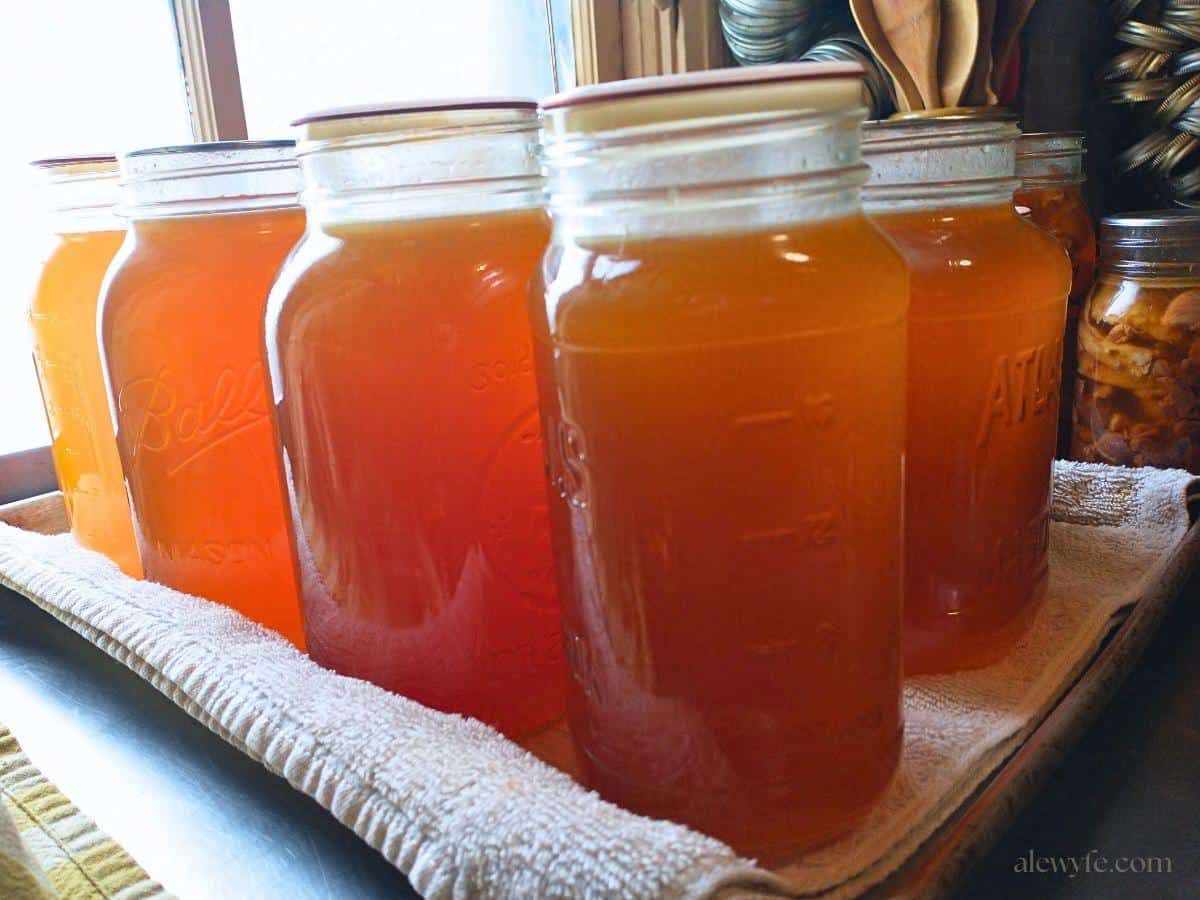
Why should you can your homemade stock?
If I haven’t already convinced you, you can make much better stock at home for less money than the so-called “stock” that is on the grocery store shelf. Even if you just use saved and frozen scraps and pressure-can them, you will end up with homemade and delicious shelf-stable nourishing bone broth or stock on your pantry shelves.
This is a great way to take advantage of a good sale on fresh or frozen chicken (even if you don’t have a giant freezer). You can also save the bones from rotisserie chickens, roasts, and your holiday turkeys or roast duck or goose and turn them into flavorful, nutritious stock.
These home-canned meat or chicken stocks are ready to use in your recipes without waiting for them to thaw (or making them more often in small batches). Homemade bone broth will add flavor and nutrients to your home cooking, as the long slow cooking process extracts all the goodness from the ingredients that you use.
Some simple recipe ideas that use your homemade bone broth or stock:
- Use your homemade stock as a base for sauces, soups, stews, and ramen.
- Cook couscous, whole grains, rice, or legumes in stock instead of water to add flavor and nutrients.
- Make homemade rice pilaf with a bit of sauteed onion, homemade stock, and your favorite kind of rice, instead of buying the over-priced boxed mixes.
- Make savory oatmeal (especially good with steel-cut oats) with broth instead of water, and top with a fried or poached egg or melted cheese and roasted vegetables.
- De-glaze the pan with stock after searing steaks, pork chops, or roasts, and make a quick pan sauce or gravy. Season to taste and thicken with a bit of roux, cornstarch, or arrowroot.
- Use the stock to hot-pack canned turkey, chicken, meat or game with your pressure canner for easy pantry meals-in-a-jar.
- Really, the possibilities are endless!
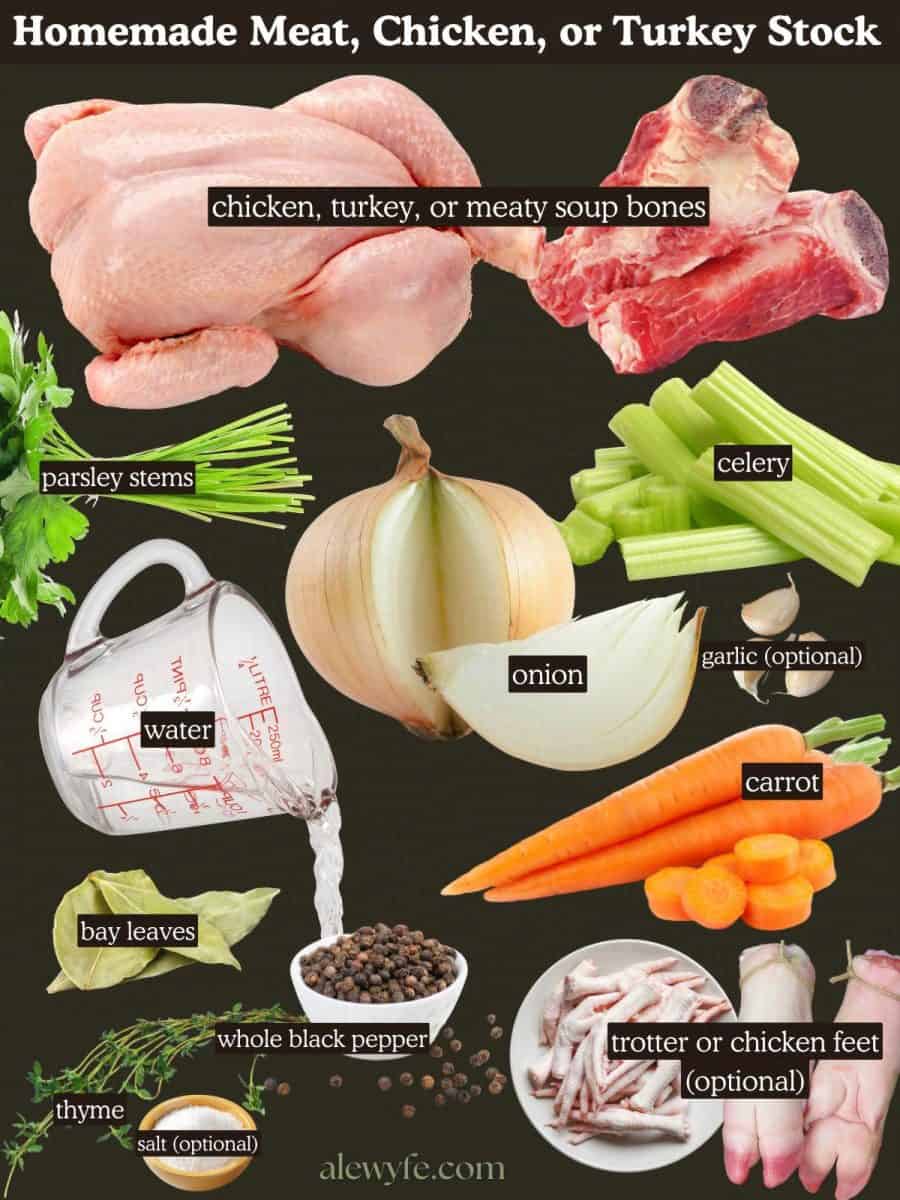
Ingredients in Homemade Poultry or Meat Stock
Chicken, Turkey, Meat, or Game Bones:
I give a large range of weights for the bones in this recipe. Beef, veal, and large game bones are very dense and heavy, while chicken, turkey, and other poultry bones are hollow and light. Use the larger range for meat stocks and the smaller weight range for poultry stocks. If you don’t have a scale, just fill your pot half to 2/3ds full of bones, then add the other ingredients and top up with water to cover by at least a few inches. It’s a rough ratio and you don’t have to get too precious about it!
For chicken or turkey stock, you can buy whole birds and break them down at home. You can sometimes buy just the backs and necks, or inexpensive leg quarters to make a rich chicken bone broth without having to do your own butchering (though once you get the hang of it, it’s pretty easy and less expensive than buying already portioned cuts).
If you are breaking down whole chickens or turkeys, save the meat for your favorite recipes. Cook or freeze the breasts, legs, thighs, and wings. Use the carcass and wing tips (and any included necks, hearts, and giblets except the livers).
For a meat or veal stock, you can buy meaty soup or knuckle bones. For the best stock, you’ll want to use a variety of bones, including knuckle bones (joints) that are rich in connective tissue. The collagen breaks down with heat into gelatin, which adds protein and a richness & mouthfeel to your stock.
If you can get them (and if your family eats pork) add one or two split pigs feet (or you can use chicken feet for a kosher alternative) to the bones for the thickest, richest stock. Adding either of these is the secret to getting stock so rich that it will set up solid when chilled, essential for making aspic and wonderfully rich sauces.
You can make a white stock with raw fresh or frozen bones, though usually I prefer to make a roasted or brown stock. For the latter, roast the raw bones in an oven until they are golden brown. You can skip this if you are using cooked bones from rotisserie chickens or roasted turkeys.
Mirepoix & other vegetables:
You could make a plain bone stock with just the bones (and a few tablespoons of vinegar to help extract the minerals), but I like to make a full-flavored stock enriched with fresh or frozen vegetables, herbs, and spices.
For a basic chicken, turkey, beef, or game stock, I add mirepoix (two parts onions to one part each carrots and celery), parsley stems, mushroom stems, green leek, scallion, or fennel tops, or whatever I have in the stock bag of little scraps in the freezer.
I save trimmings and odds and ends of vegetables, mushroom trimmings, and herb stems in a gallon zip-seal bag in the freezer, and another one for bones and meat trimmings (silverskin & roast trimmings that aren’t overly fatty, along with bones). When the bags are full (or I need room in my freezer) I make a batch of stock.
But remember, your stockpot is NOT a garbage can (or a compost bin)! Don’t use dirty carrot peels, unwashed trimmings, anything that is spoiling, slimy, or otherwise “off”. Wilting and past-prime vegetables are fine, but not molding or rotting ones! A good stock is the foundation of good cuisine, but a bad one can make decent cooking worse.
Remember that you are extracting the flavor and goodness from your ingredients, and while you can use your stocks to be thrifty & get some value from things you’d otherwise toss out, the quality of your ingredients still matters. If your ingredients are bad, your stock will not taste good, and neither will your food! Repeat after me… GIGO… Garbage In, Garbage Out. It’s not just for programming anymore!
On that note, avoid adding brassicas & vegetables from the beet family (broccoli, cabbage, brussels sprouts, chard, turnips/rutabagas/swedes) which will taste overly vegetal, bitter, & sulfurous, especially after canning.
I like to add tomato products to a lot of my stocks. A few tablespoons of deeply roasted tomato paste adds depth and umami to meat & roasted brown stocks, while tomato peels, trimmings, or diced tomatoes add brightness to poultry & lighter white (unroasted) stocks, and also to fish stocks (though those should be used fresh or frozen, not canned to preserve the delicate flavor).
Frugal tip: When I can tomatoes at home, I save the blanched skins and separate the trimmings (bruised bits & cores can go in the stock bag in the freezer, while anything that is moldy or otherwise spoiling goes straight to the compost).
Seasoning:
Season your stock with some whole peppercorns, bay leaves, parsley stems, thyme, and maybe some rosemary or oregano, especially for a lighter poultry or white veal stock.
It’s best to keep your stocks fairly neutral so that they’re versatile. You can always add layers of flavor later when you use your broth in recipes, to tailor it to the flavor profile you want and the cuisine you are cooking.
Do NOT add fresh or dried sage to a stock that you are going to can, as it turns bitter and awful tasting after pressure-cooking.
However, if you already have a fully stocked pantry shelf with plenty of plain canned proteins and stocks, you can get a bit creative with some of your broths, as long as you stick to ingredients that are safe to can!
It’s best to experiment with small batches of specialty broths to make sure you and your family like the results before canning a large batch… but for example, you could:
- Try an Asian-style broth with ginger, garlic, and soy sauce (or add some shiitake or lemongrass, or a bit of five-spice powder), that’s great in rice, stir-fry sauces, or as a base for homemade or instant ramen, pho, egg-drop, hot-and-sour and dumpling or won-ton soups.
- Or try making a Southwestern broth infused with dried chili peppers, cumin, & Mexican oregano… try it in tortilla soup, white chicken chili, posole, Spanish rice, and to make extra flavorful homemade tamales.
- The French bistro where I worked used lots of fresh fennel bulbs and tops, bay leaves, rosemary, oregano, and other Mediterranean herbs in our stocks, along with halved roasted heads of garlic, roasted tomato paste, and roasted mirepoix for a robust fully-flavored stock.
Salt:
Adding salt to your jars of stock is optional, and not necessary to preserve them. It does add flavor, but it is best to either omit or use very minimal amounts of salt, no more than a teaspoon per quart and preferably less. We were taught in culinary school NOT to salt our stocks, and there are good reasons for this!
The main concern here is that if you are using your stock to make sauces that are often very reduced while cooking. You want to be able to control the salt level of the finished dish, and if you season your stocks your sauces can be overly seasoned.
This is a huge advantage of making your own stock rather than buy the commercial stuff, which often relies on large quantities of salt to make up for the lack of flavor.
I usually add just a little bit of salt to my jars of stock, but if you’re on a sodium-restricted diet or cooking for someone who is, you can leave it out. It’s also better to omit the salt if you will be making a lot of highly-reduced sauces, rather than using your stocks full-strength to make soups or to cook rice and other grain pilaf.
Equipment Needed to Can Bone Broth or Stock
Pressure Canner:
You absolutely must use a pressure canner to safely can chicken, meat, turkey, or vegetable stock. Do not try to water-bath can low-acid foods! You also can’t safely can stock in an Instant Pot or small pressure cooker. They do not reliably build up enough pressure to safely can foods, especially low-acid foods like meat and veggies that require consistent pressure and long processing times.
Botulism isn’t worth the risk… always pressure can low-acid foods like meats and vegetables.
I love my All-American pressure canner, but any pressure canner that is large enough to hold at least four quart jars and that has a pressure weight and/or a tested pressure gauge will work. See our guide to canning equipment for some other budget-friendly recommendations:
Sheet pans or roasting tray:
You can make the stock with raw bones, but lightly roasting them first will add a lovely color and depth of flavor to your stock, and I highly recommend that you take the time to do this.
If you’re processing chickens for some reason in August without air-conditioning… first of all, “what is you doin’?”… second, do what you gotta do when you gotta do it, I guess? Otherwise, roast those bones! If you have room in your oven or work in batches, you can roast your mirepoix (stock vegetables) too.
Stock pot, large Instant Pot or Crock-pot, or Nesco Roaster:
Every cook has their own favorite way to make stock (bone broth). I usually either use a large stock pot on the stove top or our big 8 qt Instant Pot, but if you have another safe method, feel free to use it.
I usually bring the stock up to a low lazy bubble on the stove-top and skim it before bed, and then leave it on our simmer burner overnight to strain and can the next day. You can also use a large electric roasting pan for this if you have one.
Smaller batches of stock I do under pressure in the Instant Pot, which is faster, and can hold the stock at a safe temperature after pressure cooking it to extract all the flavor and minerals from the bones.
Strainer or Large Colander:
Ladle or carefully pour your finished stock through a strainer or colander, then through a fine mesh sieve or cheesecloth to get a stock with better clarity and less sediment.
A very fine micro-mesh chinois is a kitchen luxury, but if you can swing one, it will help make your stocks crystal-clear (I picked mine up at a used restaurant supply store, which is a good place to check since these are built to last for a lifetime).
Canning accessories:
Jar tongs, a jar funnel, and chopsticks or a de-bubbling wand aren’t essential but they’ll make you life a lot easier! If you have a pressure canner, you probably already have these, but if you don’t, do yourself a favor and get some.
Mason Jars and Lids:
You’ll need an assortment of quart or pint jars (or a combination of the two). You can also can in some smaller jars for convenience, but don’t try to use half-gallon jars or anything larger than a quart.
You’ll need new metal canning lids (or reusable lids with rubber gaskets, like Tattler, Harvest Guard, or Weck jars and lids, if you’re comfortable with those).
How to Can Meat, Turkey or Chicken Stock
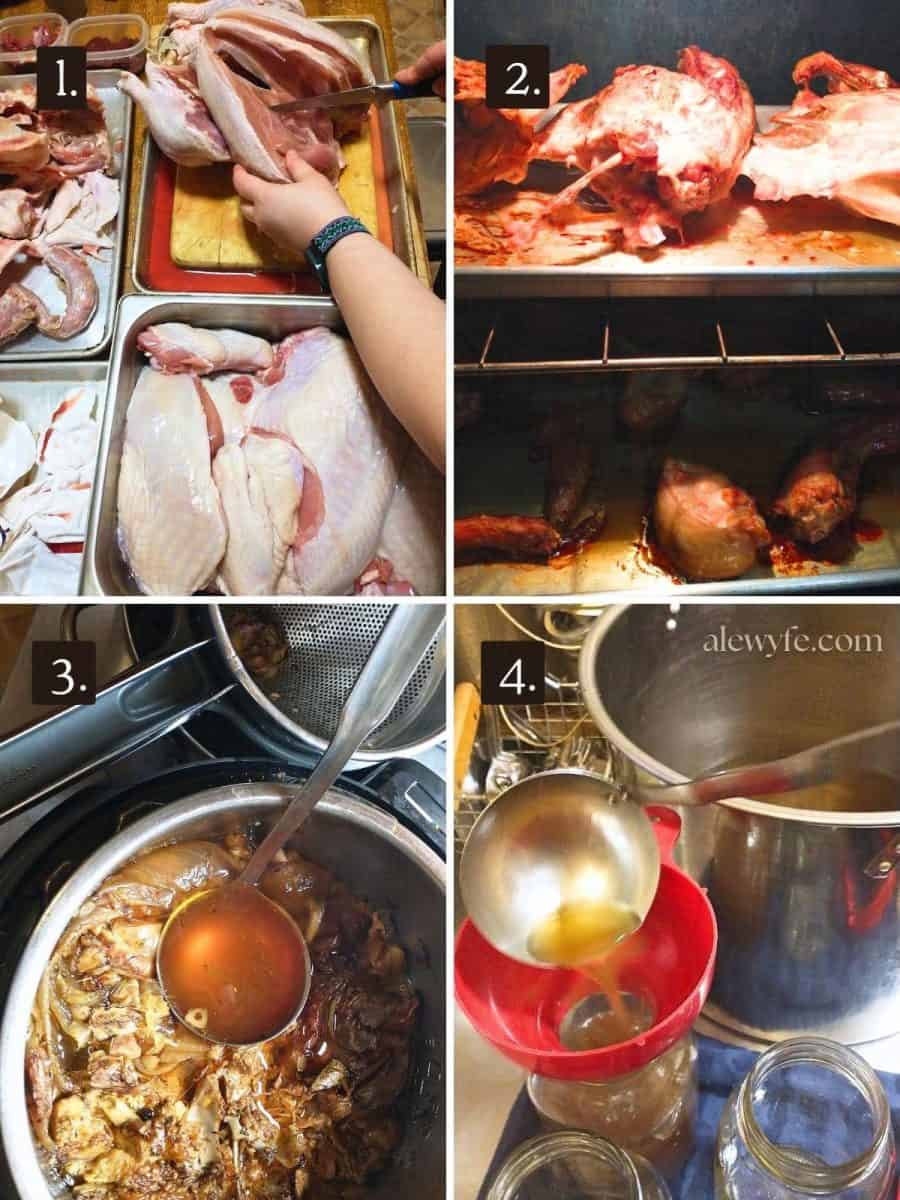
Stock Method 1 (Super-Easy Mode, No Knife Skills Needed)!
Rotisserie chicken method:
- This is the absolutely easiest shortcut! Also works for roasted turkey carcasses to turn your holiday bird leftovers into jars of canned stock… don’t stuff your bird if you’re going to do this though!
- You can buy several fully-cooked rotisserie chickens to break down for a big batch of stock and freeze the meat. You can leave the meat in large portions, or completely de-bone and dice or shred the meat to use in your favorite recipes. Up to you!
- Or, save the bones in your freezer until you have enough collected to make a large pot of stock… I usually wait until I have the backs & wing tips from 3-5 chickens or 1-2 turkeys, but this will depend on the size of your largest stockpot and how large the birds are.
- If you do this, you can skip to the section after roasting the bones.
Stock Method 2 (Still Easy, No Knife Skills Needed)!
Poach whole chickens or turkeys:
- If you aren’t handy with a boning knife or want an extra meaty flavored poultry broth, you can poach a whole chicken or two, or a small turkey in a large pot of water.
- You can roast the bird first in a roasting pan or sear it in the pot to make a darker, richer flavored stock.
- Place the whole bird in the pot, then add the veggies, herbs, seasonings, and cool water to the pot to cover the bones by at least a few inches.
- Bring up to a low, lazy simmer, and poach the whole uncooked or seared bird until the meat is just tender enough to remove from the bones.
- Carefully remove the chicken or turkey to a pan until it is just cool enough to handle. Remove the meat and set aside. Return the bones to the pot and proceed as below.
- Slice, dice, or shred the cooked meat, and either can it immediately in enough broth to cover, or refrigerate/freeze to use in your favorite recipes (soup, chicken salad, croquettes, casseroles, pasta, enchiladas, tamales, etc).
Stock Method 3 (Basic Butchery 101, or Store-bought Soup Bones)
De-bone your chickens or turkey (for whole birds):
- A stiff boning knife is best for this, but you can use a sharp chef’s knife or a stout filet knife as you prefer.
- You can do this in several ways, but I like to start with removing the breast meat pieces first:
- make a long cut on either side of the breast (or keel) bone, freeing the meat from the bone with small cuts against the rib cage
- work from the neck down towards the back of the bird, then cut downward while sliding the blade parallel to the bone with small cuts, and cutting down around the wishbone below the neck.
- repeat this slicing and scraping motion until the breast pieces are free, set aside.
- watch your fingers and pay attention to where your knife blade is… don’t cut yourself!
- Remove the wing tips and wings, then the legs, cutting carefully around the tendons to free the leg quarters, bending the ball-joints backwards and up to expose them, cutting through sinew and not bone.
- This might sound complicated, but after you do a few (or a few hundred by the case in my case, thanks to a de-boned whole chicken dish on the menu when I was an intern) you’ll get the hang of it!
Roast bones for brown stock:
- On a large sheet pan or roasting pans, roast the neck bones, wing tips, and carcasses for stock.
- Spread the bones out on the pan so that they brown (if you crowd the pans they will steam and simmer instead of browning).
- Bake about 25-35 minutes in a hot oven (375-425 F) or until the meat on the bones is golden brown.
- Remove them from the oven; don’t let them burn.
- Optional: Roast the mirepoix (onion, carrot, celery), and the tomato paste and garlic cloves, if you are using them, for an even deeper flavor.
Make bone broth:
- Place bones in a large stockpot, crock pot, or Instant Pot, along with fresh or roasted mirepoix vegetables: peeled and large chopped carrots, celery, and onion (2 parts onions to one part each carrots and celery) and any tomato product or mushrooms.
- Add a tablespoon or two of black peppercorns, a few bay leaves, parsley or parsley stems, and other fresh or dry herbs if you like. Don’t use sage! It turns bitter when pressure canned.
- Top up with enough cool water to cover the bones and vegetables by about 3-4″.
- Note: If you are using an 8 qt Instant Pot to make the stock, cover the bones up to the max fill-line. You can add water after straining or make a second stock/remi to make up the volume to can a full 7 quarts of stock (see next section).
- Simmer stock over medium-low to low heat at a very low, lazy bubble for at least 3 hours for chicken or turkey stock, or 6-8 hours or overnight for beef, veal, and large game bones.
Strain & skim stock:
- Strain stock by carefully ladling or pouring it through a colander or chinois and then a fine mesh strainer & keep hot (or immediately chill the broth to de-fat it and add back to a second stock, see below).
- For extra clarity, ladle the broth carefully through the strainer rather than pouring, and pass the strained stock through a layer of cheesecloth or a micro-mesh chinois.
- Carefully skim any excess fat from the top of the finished stock with a ladle.
- You can also chill the stock quickly and remove the solidified fat layer on top before bringing it back up to a simmer. This is especially helpful if you are making a two-step stock, as most of the rendered fat will be in the first stock.
Make a remouillage (optional second lighter stock):
- If you’d like, especially if you did a shorter cook time on your initial stock, you can make a second light stock or remouillage (meaning “rewetting”, or “remi” for short in pro-kitchen parlance) with your stock bones.
- In very classical French cuisine, the first and second stocks from veal bones would often be combined, and then reduced together to make a concentrated stock base, or demi-glace, to use in sauces.
- You can also use this method with a poultry stock that is cooked for a shorter period of time, especially if you are using an Instant Pot to make a very concentrated stock with minimal water to cover the ingredients vs using a very large stockpot.
- Add fresh mirepoix vegetables (onion, carrot, celery, optional leeks &/or tomato) to the pot, and top up again with cool water and repeat the process.
- This second stock is lighter in color and flavor, but is good for cooking rice or other grain pilaf, as a soup base, and more.
- If you are making bone broth to can whole turkeys, chickens, or meat, this method is particularly helpful. You can make a quick primary stock from the necks and de-boned carcasses and use this broth to can the turkey breast and de-boned dark meat.
- Then, add the wing and leg bones from the turkey or chickens to your remi stock after prepping the meat for canning, and can this batch of remi stock after you’ve finished pressure canning the meat in broth.
- You can slow cook the second stock and strain and process it after canning the meat, or even the next day if you either strain and quickly chill it or keep it at a very low simmer (no less than 185-205 F).
Pack jars for processing:
- Place the recommended amount of warm water in the bottom of your canner (check your pressure canner manual, but usually 3-4″ of water) and begin to preheat the canner.
- Pack clean, hot quart and/or pint mason jars with the strained broth, leaving 1″ headspace at the top.
- If you run out of prepared stock before completely filling the jars, you can use boiling water to top up your jars to the proper headspace, or chill the remaining stock if you don’t have enough to fill all the jars completely.
- You can add up to a teaspoon of salt to each quart jar (half teaspoon per pint) if you like. This isn’t necessary for food safety but adds flavor.
- Wipe the jar rims with a lint-free cloth or paper towel dampened with hot water or white vinegar. Top with new canning lids and jar rings.
- If you have more stock than will fit in the canner in one batch, keep it hot while the first batch processes. Or, you can refrigerate or freeze extra stock. Use refrigerated stock within a few days or freeze for up to six months (it’s safe to freeze longer but more likely to freezer burn or pick up off flavors).
Pressure can the jars:
- Carefully place the filled jars into the preheated canner.
- Check that the canner vent isn’t clogged and close & seal the lid. Bring the canner up to pressure over medium heat with the vent open, and once the canner is venting a steady stream of steam, set a timer for 10 minutes.
- When the canner has vented for 10 minutes, regulate the heat if necessary and drop the weight over the vent (or close the petcock if you have an older unweighted dial-gauge canner).
Can quarts of stock for 25 minutes (20 minutes for pints) at 11 PSI dial gauge/10 PSI weighted gauge up to 1000 ft (adjust for higher altitudes using the chart below).
| Altitude Feet | Weighted Gauge | Dial Gauge |
|---|---|---|
| 0- 1,000 | 10 | 11 |
| 1,001- 2,000 | 15 | 11 |
| 2,001- 4,000 | 15 | 12 |
| 4,001- 6,000 | 15 | 13 |
| 6,001-8,000 | 15 | 14 |
| 8,001-10,000 | 15 | 15 |
Start your processing timer only once the appropriate PSI has been reached (11 PSI on a dial-gauge canner for up to 2000 ft, see chart for altitude adjustments), or when the weight is jiggling to indicate that the proper pressure has been reached.
Watch or listen carefully, adjust heat gradually as needed, and reset the timer to zero and restart processing time if you lose pressure below the correct processing pressure at any point.
Remove & cool the jars (+ can additional batches or stock):
- After the processing time is complete, turn the heat off. Once the pressure canner has cooled and returned to neutral pressure (the dial will drop to zero, and no steam escapes from the weight or petcock if jiggled) you should open the canner and remove the jars (follow your canner instructions for opening).
- Remove the jars from the canner using jar tongs or the jar rack.
- Place the jars on a folded dish towel, cooling rack, or wooden surface. Protect hot jars from cold surfaces like granite, stainless, or concrete countertops until they have cooled. The thermal shock can break your jars if you put a hot jar on a cold surface- tragic, if it’s full of your lovingly made stock!
- Process additional batches if needed. You can also chill the stock for up to three days before reheating and canning it if you are short on time, use it right away, or freeze it.
Storing your Canned Homemade Stock
- Let the hot jars cool in a draft-free place where they can rest overnight or for up to 24 hours.
- Don’t touch the rings until the jars have completely cooled and the seals are set (disregard this for Tattler/Harvest Guard reusable lids only; for these, follow manufacturer instructions to carefully tighten rings immediately after removing from the canner).
- Remove the rings and check the seals on the jars after they have rested at least overnight or a minimum of 8 hours.
- Metal canning lids will ping and have a clearly depressed seal-button in the center of the jar, and reusable lids (Weck & Tattler jars) will have a strong vacuum seal holding the lids firmly in place without the clips or rings, and seal failure is very apparent.
- Promptly freeze or refrigerate any jars that did not seal and use within a few days. You can also reprocess these jars within 24 hours.
- Gently wash all sealed jars with soapy water, label clearly, and store in a cool, dark place. Do not stack jars or store them with the rings on.
- Protect jars from freezing or other extremes of temperature in storage.
- Safely discard the contents of any jars that lose their seals in storage or show signs of spoiling (off-flavors or aromas, hissing, bubbling, or spurting when opened, or any mold) and sterilize jars before reuse.

How to Make and Can Meat, Chicken or Turkey Stock
Equipment
- 1 8 Qt Instant Pot (to make the stock, NOT to can the finished stock)
- 1 jar lifters or tongs or jar rack with handles
- colander, chinois, or fine mesh strainer
Ingredients
- 2 gallons cold water approximate, enough to cover bones & top up as needed
- 5-15 lbs chicken, turkey, beef, veal, or game bones use less for lighter stock, or more for a richer broth for classical French sauces or consomme. Alt method: whole chicken/turkey, see notes or post for more details & about weight ranges
- 1 lb onion quartered or roughly chopped
- 8 oz carrots peeled & roughly chopped
- 8 oz celery washed & roughly chopped
- 1 tbsp whole peppercorns
- 3-5 med-large bay leaves
Optional ingredients (use some or all of these):
- 1 large pig's foot (trotter) (omit or sub 6-8 oz chicken feet, either is a good source of gelatin)
- 1-2 tbsp distilled white vinegar or apple cider vinegar (optional, aids mineral extraction from bones)
- 1 bundle parsley stems (save leaves for cooking, use stems in stock)
- 2-3 sprigs fresh thyme (sub 1 tbsp dried thyme leaves)
- 1 bundle green leek tops, well washed (optional)
- 1 head garlic (optional, or less) cut in half lengthwise, root & stem discarded
- 2 oz roasted tomato paste or other tomato product (optional, or sub tomato peels & cores, or large diced tomato)
Instructions
Roast bones for brown stock:
- On a large sheet pan or roasting pans, roast the neck bones, wing tips, and carcasses for your stock, unless you are making a white stock or your bones were already roasted.
- Spread the raw bones out on the pan so that they brown (if you crowd the pans they will steam and simmer instead of browning).
- Bake about 25-35 minutes in a hot oven (375-425 F) or until the meat on the bones is golden brown.
- Remove them from the oven; don't let them burn. Deglaze the pans with water and add this "fond" to the stockpot, unless it is burnt.
- Optional: Roast the mirepoix (onion, carrot, celery), and the tomato paste and garlic cloves, if you are using them, for an even deeper flavor.
Make bone broth:
- Place the bones in a large stockpot, crock pot, or Instant Pot, along with fresh or roasted mirepoix vegetables: peeled and large chopped carrots, celery, and onion (2 parts onions to one part each carrots and celery) and any tomato product or mushrooms.
- Add a tablespoon or two of black peppercorns, a few bay leaves, parsley or parsley stems, and other fresh or dry herbs & spices if you like. Don't use sage! It turns bitter when pressure canned.
- Top up with enough cool water to cover the bones and vegetables by about 3-4".
- Note: If you are using an 8 qt Instant Pot to make the stock, cover the bones up to the max fill-line. You can add water after straining or make a second stock/remi to make up the volume to can a full 7 quarts of stock (see next section).
- Simmer stock over medium-low to low heat at a very low, lazy bubble for at least 3-4 hours for chicken or turkey stock, or 6-8 hours or overnight for beef, veal, and large game bones.
- Strain stock by carefully ladling or pouring it through a colander and then a fine mesh strainer or chinois & keep hot. For extra clarity, ladle the broth carefully through the strainer rather than pouring, and pass the strained stock through a layer of cheesecloth or a micro-mesh chinois.
- Carefully skim any excess fat from the top of the finished stock. You can also chill the stock quickly and remove the solidified fat before bringing it back up to a simmer (esp if you are making a two-step stock, as most of the rendered fat will be in the first stock).
Make a remouillage (optional second lighter stock)
- You can make a remouillage ("remi", meaning "rewetting") or second light stock with your stock bones after straining the first rich broth. You can treat these as two separate products, or combine the first and second stock for a single medium-bodied stock.
- This second stock is lighter in color and flavor, but is good for cooking rice or other grain pilaf, as a soup base, and more.
- Add fresh mirepoix vegetables (onion, carrot, celery, optional leeks &/or tomato) to the pot, and top up again with cool water and repeat the process.
- If you are making broth to can whole turkeys or chickens, this method is particularly helpful. You can make a primary stock from the necks and carcasses to make a broth to can the chicken or turkey breast and de-boned dark meat.
- Then, add the wing and leg bones from the turkey or chickens to your remi stock after deboning the meat for canning, and can this second batch of remi stock after you've finished pressure canning the meat in the first broth.
Pack jars for processing
- Place the recommended amount of warm water in the bottom of your canner (check your pressure canner manual, but usually 3-4″ of water) and begin to preheat the canner.
- Pack clean, hot quart and/or pint mason jars with the hot strained bone broth, leaving 1" headspace at the top of each jar.
- If you run out of prepared stock before completely filling the jars, you can use boiling water to top up your jars to the proper headspace, or chill the remaining stock if you don't have enough to fill all the jars completely, or transfer to a smaller jar (process combined size batches of qts & pints for the longer processing time).
- You can add up to a teaspoon of salt to each quart jar (half teaspoon per pint) if you like. This isn't necessary for food safety but adds flavor.
- Wipe the jar rims with a lint-free cloth or paper towel dampened with hot water or white vinegar. Top with new canning lids and jar rings.
- If you have more stock than will fit in the canner in one batch, keep it hot while the first batch processes. Or, you can refrigerate or freeze extra stock. Use refrigerated stock within a few days or freeze for up to six months (it’s safe to freeze longer but more likely to freezer burn or pick up off flavors).
Pressure can the jars
- Carefully place the filled jars into the preheated canner.
- Check that the canner vent isn’t clogged and close & seal the lid. Bring the canner up to pressure over medium heat with the vent open, and once the canner is venting a steady stream of steam, set a timer for 10 minutes.
- When the canner has vented for 10 minutes, regulate the heat if necessary and drop the weight over the vent (or close the petcock if you have an older unweighted dial-gauge canner).
- Can quarts of stock for 25 minutes (20 minutes for pints) at 11 PSI dial gauge/10 PSI weighted gauge up to 1000 ft (adjust to 15 at higher altitudes with a weighted canner). See notes for altitude adjustments.
- Start your processing timer only once the appropriate PSI has been reached (11 PSI on a dial-gauge canner for up to 2000 ft, see notes for altitude adjustments), or when the weight is jiggling to indicate that the proper pressure has been reached. Watch or listen carefully, adjust heat as needed, and reset the timer to zero and restart processing time if you lose pressure below the correct processing pressure at any point.
- After the processing time is complete, turn the heat off. Once the pressure canner has cooled and returned to neutral pressure (the dial will drop to zero, and no steam escapes from the weight or petcock if jiggled) you should open the canner and remove the jars (follow your canner instructions for opening).
- Remove the jars from the canner using jar tongs or the jar rack.
- Place the jars on a folded dish towel, cooling rack, or wooden surface. Protect hot jars from cold surfaces like granite, stainless, or concrete countertops until they have cooled.
- Process additional batches if needed. You can also chill the stock for up to three days before reheating to a simmer and canning it if you are short on time.
Storing your canned homemade stock
- Let the hot jars cool in a draft-free place where they can rest overnight or for up to 24 hours.
- Don’t touch the rings until the jars have completely cooled and the seals are set (disregard this for Tattler/Harvest Guard reusable lids only; for these, follow manufacturer instructions to carefully tighten rings immediately after removing from the canner).
- Remove the rings and check the seals on the jars after they have rested at least overnight or a minimum of 8 hours.
- Metal canning lids will ping and have a clearly depressed seal-button in the center of the jar, and reusable lids (Weck & Tattler jars) will have a strong vacuum seal holding the lids firmly in place without the clips or rings, and seal failure is very apparent.
- Promptly freeze or refrigerate any jars that did not seal and use within a few days. You can also reprocess these jars within 24 hours.
- Gently wash all sealed jars with soapy water, label clearly, and store in a cool, dark place. Do not stack jars or store them with the rings on.
- Protect jars from freezing or other extremes of temperature in storage.
- Safely discard the contents of any jars that lose their seals in storage or show signs of spoiling (off-flavors or aromas, hissing, bubbling, or spurting when opened, or any mold) and sterilize jars before reuse.
Notes
Instant Pot Note: If you are using an Instant Pot to make the stock, cover the bones up to the max fill-line. You can add water after straining or make a second stock/remi to make up the volume to can a full 7 quarts or 14 pints of stock to fill your canner.
Altitude Adjustments for Canning Stock:
Processing times remain the same (25 minutes for quarts, 20 minutes for pint or smaller jars). Adjust pressure for weighted gauge: 15 lb for any altitude above 1000 ft. Adjust pressure for dial gauge: 0-2000 ft (11 lb) 2001-4000 ft (12 lb) 4001-6000 ft (13 lb) 6001-8000 ft (14 lb)Source: USDA Guide 5, Preparing and Canning Poultry, Red Meats, and Seafoods
No-Knife Skills/Whole Bird Broth Method:
Poach whole chickens or turkeys:
-
- If you aren’t handy with a boning knife or want an extra meaty flavored poultry broth, you can poach a whole chicken or two, or a small turkey in a large pot of water instead of deboning them.
-
- You can roast the bird first in a roasting pan or sear it in the pot to make a darker, richer flavored stock.
-
- Place the whole bird in the pot, then add the veggies, herbs, seasonings, and cool water to the pot to cover the bones by at least a few inches.
-
- Bring up to a low, lazy simmer, and poach the whole uncooked or seared bird until the meat is just tender enough to remove from the bones.
-
- Carefully remove the chicken or turkey to a pan until it is just cool enough to handle. Remove the meat and set aside. Return the bones to the pot and proceed as above until the stock has a rich full flavor and is ready to strain and can.
More Pressure-Canning or Freezer-Meal Recipes:
- Zuppa Toscana – Sausage, Potato, Kale and White Bean Tuscan Soup (Canning or Meal-Prep Recipe)
- Hearty Chicken & Mushroom Stew or Pot Pie Filling
- Authentic Bistro-Style French Onion Soup (Canning or Meal-Prep Recipe)
- Five-Alarm Venison or Beef Chili (Canning or Meal-Prep Recipe)
- Homemade Spaghetti Sauce with Meat and Mushrooms
- How To Can Swedish Meatballs
- Canning Cajun Red Beans and Sausage
- Garlic and Herb Potatoes (Easy Raw-Pack Canning Recipe)
- Enchilada Roja Sauce (Pressure-Canner or Freezer Recipe)